One of my goals for this blogging thing is to get the info that helped me out to you Readers.
This first post is about something we all struggle with. If you’re an aging athlete (Read: old & active) you know about this all too well –
I N J U R Y
I am fresh off a full year of arduous rehab that took all my patience. Yes, a full year to get myself back to baseline.
Not being able pursue your goals – active or otherwise – Fully sucks.

Never in my life has an injury kept me on the sidelines for more than 3 months. I was back from both my knee scopes in 7 weeks.
A Year?
WTF!
Why so long?
Easy answer there.
I couldn’t get the right diagnosis and spent 4 months following the wrong path. Don’t always take what a doctor or physical therapist tells you as Gospel.
They make mistakes too.
OR – they aren’t skilled enough to sleuth out the ROOT CAUSE OF YOUR INJURY.
Most will just treat where the pain is and happily put you on a schedule of 2 visits a week for 8 weeks.
What!
Co-pay after Co-pay.
Too much unnecessary stress on my wallet, insurance, and resolve to get better.
So what was wrong with you?
I initially had a calf strain that lingered and lingered. My calf muscle would super tighten up so much that it would almost seize anytime I ran more than 2 miles.
You can read a nice essay and how that injury happened and how I dealt with it mentally HERE.
After 4 months of wasted PT and 2 months of general nothingness and malaise, I found a chiropractor that specializes in soft tissue treatment and repair. His website is loaded with practical info about injuries that sounded a lot like mine.*
I got excited.
My motivation returned to rehab right and rehab hard.
I was mentally running again.
Just needed that calf to get on board to make it happen in reality.
I read this great piece of advice from another injured trail runner that further inspired me:
“Be as a serious about treating your injury as you are about training.”
From The Runner’s Trip – 5 Truths about Running Injuries
With that in mind and following a strategy from the same blog, I made a detailed timeline of what happened to my calf and when. I included as much info as I could remember. Then I emailed this to the Doctor before the first appointment.
Similarly, as I progressed with his treatments and began running again, I would email him updates describing the effort, how my body responded, and where any discomfort existed.
This is the original email I sent to him:
Calf Injury Timeline
January 2014: I’m on a regular trail run and during a fartlek of around 75% max effort I feel the initial strain in my right calf. It’s sudden – not terribly painful, but I know it’s messed up. I lightly jog 2 miles back to my car.
Early February 2014: I rest for 8 days then try another short, light run. No issues for the first 2 miles. Then into the 3rd mile, it begins to tighten so I stop the run.
Mid February 2014: Rest 10 days, try a run, and get the same results as above
February to April 2014: Rest for 2 months and hit the yoga studio 1-2 times a week. I mix in some bike commutes to work which I can do without issue. During this time, I barely notice that I have a problem. No pain while walking.
April 2014: I try to slowly come back by hiking mixed with 3-5 minute light jogging spurts. I do this twice a week all through April. It’s okay and I don’t get the same tightening, but I can still tell my calf is compromised. In late April, I do 4 miles and up the tempo slightly to see if the calf will hold up. I get 3-1/2 miles then it fully tightens, so much so that I have to stop.
May 2014: I start the first of 8 physical therapy sessions. They combine light massage, strength and stretching and finish with ice stim. After 6 sessions there is not much improvement so they do 2 sessions of dry needling. No improvement.
June 2014: Frustrated and running out of insurance covered PT sessions, I seek out a chiropractor that can do ART (active release technique). 4 sessions of this and no improvement. The Doctor recommends maybe an MRI or another specialist. I feel that that this practitioner was just not good at the technique.
July 2014 to Present: In order to stay active and keep from going crazy, I’ve been doing 3-4 mile-ish hikes and continuing with bike commuting. I can do all this without discomfort. The calf is a little stiff in the mornings, but I don’t notice the strain much at all during these non-running activities or during work.
The ability to run is 0% better since January.
———————————————————————————————
That’s a lot of info right?
A worthy doctor with any interest in helping you will read his emails from patients.
I did this for a couple reasons:
- It’s easier to process a problem if you read it. I could have spoken all this during our first appointment. But, I wanted the doctor to take all this in at a slow pace. I wanted him to consider and mentally chew on my issue well before I got into that exam room.
- I might forget something when telling it to him. This way, it’s all written down where I can add and edit before hitting send.
- Doctors are busy. Their days are usually full. They are keeping a schedule which means you are done with a regular treatment appointment in 20 minutes.
You’re out – NEXT!
I want the Doc working on my leg not listening me talk about it. That’s more minutes of treatment and less blah, blah, blah. He read your email and already knows what to do.
Talk, email, write letters. Give the Doc multiple avenues of info before you go to the first appointment.
Don’t be afraid to walk away if the results ain’t happening or your gut says, “I’m on the wrong path”.
Not all therapists and doctors know exactly what’s going on with you. They may seem confident, but without an MRI report, it’s all speculative.
So what was the deal with your calf? How was it treated?
It turns out, the problem wasn’t with my calf at all.
I’ve played lacrosse at various levels for 30+ years. That’s a ton of stress on my hamstrings. I had a major hammy pull in college that I never got treated then subsequent pulls and strains over the next two decades.
That means the back of my legs are loaded up with scar tissue.
Pulls and strains mess up the smooth pattern of your muscle/tendon/soft tissue fibers. When your body heals those areas it just patches the trauma point. This leaves your muscle or tendon less flexible and less able to handle the running things you want it to.
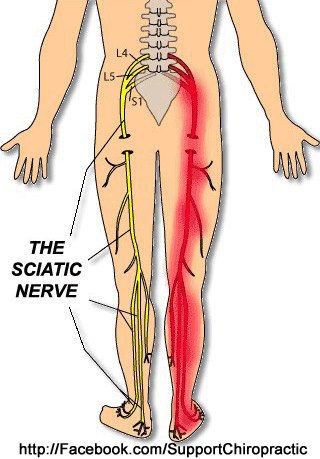
I had layers of scar tissue in my hammy which then ensnared my sciatic nerve.
Big trouble!
The sciatic nerve runs from your lower back down to your heels and is involved in all of the action in the back of your body.
This image from The Joint Mira Mesa
Mine was getting yanked all over and wreaking havoc – right calf, both hips, both glutes, and my lower back were all on puppet strings controlled by that bullying nerve
This could not be fixed with rest, ice, heat, elevation, compression, yoga, those wimpy PT strengthening exercises, acupuncture, or any other voodoo.
The only thing that works to fix this is to break up the layers of scar tissue and straighten out those tissue, tendon, and muscle fibers.
No easy task, but I was up for it. My mental state was suffering without running the trails
-And, damn it all! I’m too young for the recliner and newspaper all day on Sunday.
The Doc used a combination of Active Release Technique (A.R.T.) and Graston Technique to literally straighten me out.**
A.R.T. is a deep massage where the Doc digs into the muscles to loosen and break up adhesions in the soft tissue (scar tissue). But, you don’t just lay there. You move your body per instruction while the Doc applies pressure and tension to specific trouble spots (in my case – hammys, glutes, and hips).
The theory with Graston Technique is the same as A.R.T, but tools are used to literally scrape and catch the scar tissue from the skin surface into the tissue.
Think of it like combing out the knots in in your hair after a day at the beach.
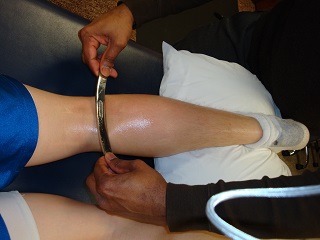
The above image is from Auro Physical Therapy Kalamazoo, MI
I know it sounds rudimentary and torturous.
Mildly painful for sure. But, it’s that good pain – that “this is good for me pain” – healing pain.
You will love it because the relief is immediate and, depending of the severity of the injury, you can start some light running the next day.
The take aways from this post are no secret:
- Find the right doctor: Don’t skimp on the research here. This is the most critical decision you’ll make about your recovery time.
- Give him/her as much information about your injury as you can – what happened, when, where’s the pain, is it consistently the same – if not, why? What’s different….etc. Remember: Email the Doc before the appointment.
- Go at your rehab with focus and urgency – the same way you train.
Good luck out there my people.
Please feel free to comment on your own injury angst and success. Sharing it helps others avoid the same mistakes.
As for me, I’m back on the trails – 69 total miles in April. 155 Total miles in May. June looks even better.
*Read about scar tissue at the Wellness in Motion website HERE
 FIVE BAG FIT
Leave a comment